


Skin-to-Skin: Your Baby’s Built In Reset Button

Updated: Mar 5

If your baby feels uncomfortable, unsettled, gassy, overstimulated, or unable to sleep, their body is not asking for more tricks or tools. Their nervous system is asking for safety.
Skin-to-skin is your baby’s built in reset button.
Placing your baby directly on your bare chest is one of the fastest and most effective ways to calm their body, support digestion, reduce crying, and help them settle into restorative sleep. It also calms your own nervous system at the same time. This is why we share skin-to-skin education with every family we serve in our office.
Skin-to-skin is not just something to do right after birth. It continues to support babies throughout infancy and beyond.
As Dr Susie Ludington, a leading researcher in skin-to-skin care, shares,
Skin-to-skin contact is not a nicety. It is a medical and developmental necessity.
What skin-to-skin does for your baby
When your baby rests skin-to-skin on your chest, their body responds immediately.
Research shows skin-to-skin helps to:

• Reduce crying
• Decrease pain and discomfort
• Increase calm and sleepiness
• Improve sleep quality and sleep organization
• Support digestion and gut comfort
• Strengthen immune function
• Support healthy brain development
• Lower stress hormones in both baby and caregiver
This is not just about bonding. It is about regulation.
Studies show that early and ongoing skin-to-skin is the only known intervention that can reduce infant crying by up to ten times. Babies whose needs are met quickly through skin-to-skin often cry less because their nervous system does not have to escalate into distress.
In studies where the only intervention was skin-to-skin, babies diagnosed with colic cried significantly less, decreasing from an average of 3.5 hours a day to 1.7 hours.
Skin-to-skin and your baby’s brain
Your baby’s brain grows best in an environment of safety and connection.
Research shows:
• Skin-to-skin accelerates brain growth
• Babies who received 90 minutes of skin-to-skin four days a week for eight weeks showed more advanced brain maturation
• Better motor development is seen between 12 and 18 months
• Long term studies show stronger parent child relationships later in childhood

Dr Nils Bergman, a physician and neuroscientist, explains it simply,
The place for a newborn baby is on its mother’s chest. There is no other place that better supports the infant’s physiology.
When babies feel safe, their bodies can focus on growth, digestion, learning, and development rather than survival.
Secure attachment does not create dependence. It creates confidence and independence later on.
Skin-to-skin and sleep
Skin-to-skin naturally induces sleep in all infants.
It helps organize sleep cycles and supports deeper, more restorative rest. Holding your baby skin-to-skin for at least one hour after they fall asleep allows them to complete a full sleep cycle, which supports healthy brain wiring.
This is especially helpful for babies who struggle with reflux, tension, feeding fatigue, or difficulty settling.
Skin-to-skin also lowers overall stress in the body, protecting organs and metabolism from long term wear and tear.
As Dr Susie Ludington-Hoe reminds us,
Babies cannot regulate themselves. They rely on the caregiver’s body to do that for them.
How to practice skin-to-skin safely
We teach families these simple steps:
Remove any clothing from the bellybutton up on both baby and caregiver. This includes no bra for those who wear them.
Baby’s shoulders rest flat against your chest. Their head is turned to the side and high enough that you can easily kiss or sniff the top of their head.
Baby’s mouth and nose stay visible and uncovered at all times.
Make sure baby’s airway is protected and the chin is not tucked. You can fit 1-2 fingers between baby's chin and chest
Baby’s arms and legs are gently flexed with hands up and knees in a frog like position.
Place a blanket over baby’s back to keep you both warm.
This position allows your baby’s nervous system to fully settle and reset.

Why clothing access matters
Many parents want to practice skin-to-skin more often but find it harder once they are home.
Getting undressed can feel disruptive. Babies wake. Parents worry about warmth or ease. Over time, skin-to-skin happens less often even though it remains just as important.
Bonsie clothing is designed to make skin-to-skin simple and accessible. Their open design allows parents to place baby chest to chest quickly without fully undressing or disturbing a calm baby.
Our footie is unlike any other on the market. Two double layered flaps are fastened together with ultra soft hook and loop fasteners. Once the two flaps are open, the baby's chest and belly are fully exposed for skin to skin connection. The elastic waistband allows for easy dressing and (as easy as they can get) diaper changes.
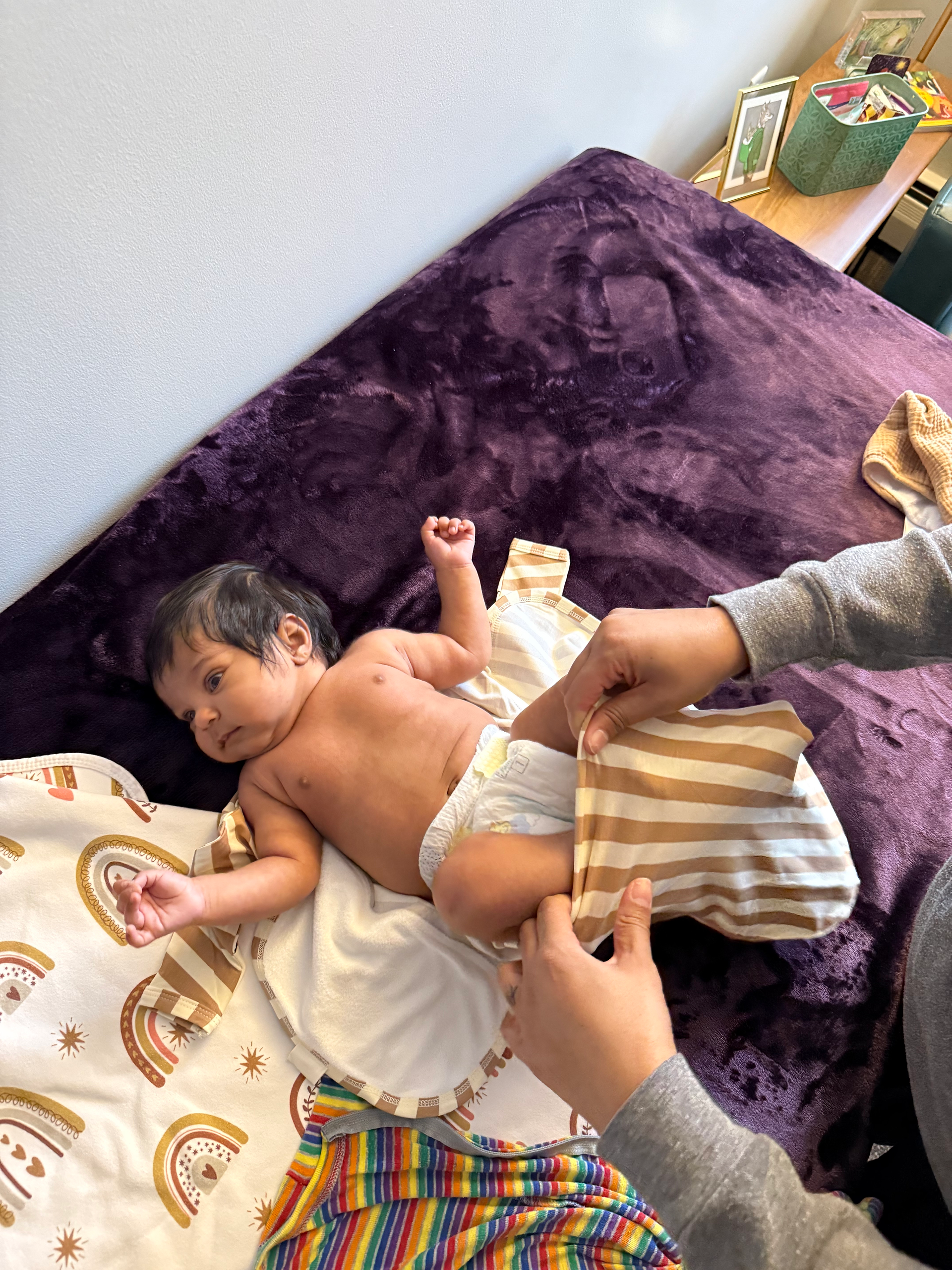


When skin-to-skin is easy, families do it more often. When they do it more often, babies benefit more fully.

In our clinical experience, we see better regulation, smoother feeding, and easier settling when skin-to-skin becomes part of daily life rather than something saved for the newborn stage. To save 15% use the code Bonsie15.
Even better- add a baby carrier

One of the easiest ways to practice skin-to-skin more often is by using a baby carrier.
Many parents share that they put on their stretchy wrap first thing in the morning and wear it like a top. Since it can look similar to a tank top, it becomes part of their daily clothing, making it easy to place baby skin-to-skin, take them out, and pop them back in throughout the day.
Babywearing supports regulation through warmth, movement, and closeness. When combined with skin-to-skin, families often notice easier calming, improved digestion, longer naps, and smoother transitions between sleep and wake.
Babywearing Educator, Karla Gabriela, in her blog post, Babywearing and Oxytocin, said,
Their bodies settle because they are close to yours. Each time you respond quickly while they’re in the carrier, their brain encodes: I am safe. My needs are met. The world is secure. Oxytocin reinforces this loop.
When paired with access clothing like Bonsie, skin-to-skin becomes simple and repeatable without fully undressing or waking a calm baby, making it a realistic part of everyday life.
Skin-to-skin for non birth parents and other caregivers
Skin-to-skin is not only for the birth parent. Non birth parents and other caregivers benefit in powerful ways as well.
Research shows that skin-to-skin contact increases oxytocin and decreases cortisol in fathers and non birth parents, just as it does for the birth parent. These hormonal shifts support bonding, confidence, and emotional attunement.

Studies have shown that fathers who practice regular skin-to-skin become more responsive to their baby’s cues and more attentive to their needs. Brain imaging research suggests that caregiving circuits strengthen with repeated skin-to-skin contact, supporting a caregiver’s ability to notice, respond, and feel connected to their baby.
For babies, skin-to-skin with non birth parents offers the same nervous system benefits. Regulation, warmth, safety, and comfort do not come from one body alone. Babies are designed to co regulate with trusted caregivers.
Skin-to-skin helps build connection, confidence, and competence for everyone involved, supporting a strong caregiving team around the baby from the very beginning.
Not just for newborns
Skin-to-skin continues to support babies well beyond the early weeks.
It is especially helpful for:
• Feeding challenges
• Digestive discomfort
• Post tongue tie support
• Nervous system regulation
• Emotional and social development
• Building parent confidence
How this fits into our care
Skin-to-skin recommendations in our craniosacral therapy practice are informed by the work of Dr Susie Ludington-Hoe, Dr Nils Bergman, and decades of peer reviewed research on infant neurodevelopment, regulation, and attachment. Dr Ludington-Hoe reminds us,
Get all infants into Kangaroo Care (skin-to-skin) as early and as often as for as long as possible to maximize their potential and that of the next generation.

This is why we discuss skin-to-skin with every family and provide a babywearing fit check as part of all of our Infant Immersion Programs at Nourish and Align. We want families to feel confident using their own bodies, connection, and movement as powerful tools to support their baby.
Your body remains your baby’s most powerful place of calm.
Austin & Kate
Sources:
Ludington-Hoe, S. M., Morgan, K., & Abouelfettoh, A. (2008). A clinical guideline for implementation of kangaroo care with premature infants of 30 or more weeks’ postmenstrual age. Advances in Neonatal Care, 8(3), S3–S23.
Ludington-Hoe, S. M. (2011). Kangaroo Care: The Best You Can Do to Help Your Preterm Infant. Bantam Books.


Comments